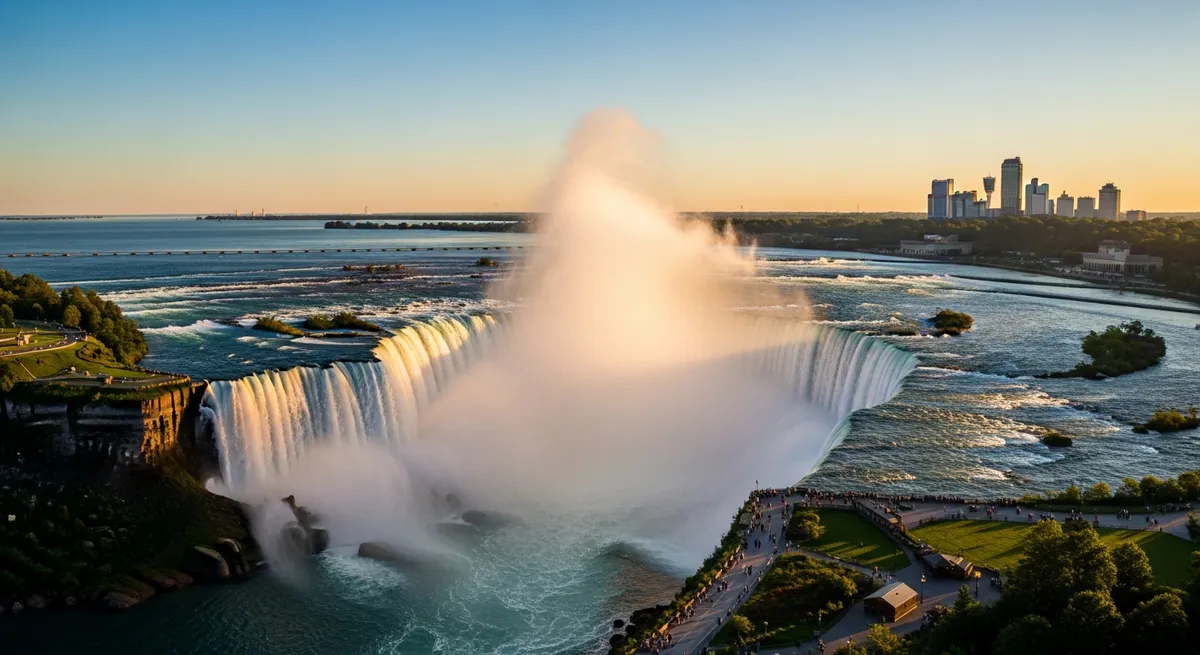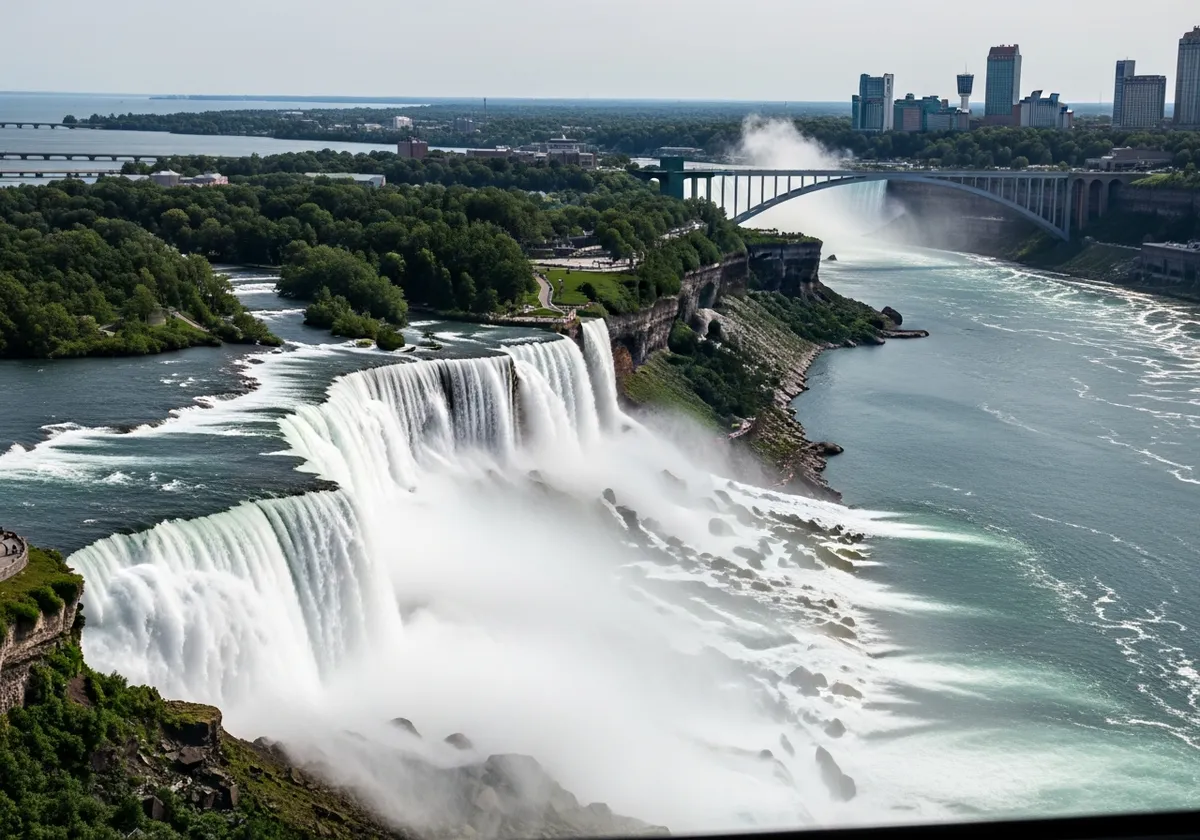
On a Niagara Falls helicopter tour you see all three waterfalls from the air — Horseshoe, American and Bridal Veil — along with the Niagara River, the Whirlpool and Spanish Aero Car, the gorge, the Rainbow Bridge and Queen Victoria Park. The 12-minute flight traces roughly 27 kilometres of the Niagara Parkway, and on a clear day you can even pick out the Toronto skyline to the north. It is the one vantage point where the whole story of the falls fits into a single window.
Most people arrive at Niagara having seen the falls from the ground, the observation decks and the boats at water level. All of those are worth doing. But none of them shows you the shape of the place: the way the river bends, drops into the gorge, spins through the Whirlpool and finally curls over a horseshoe-shaped cliff. From 500 feet up, that shape snaps into focus. This guide walks the flight in the order you'll actually fly it, so you know what's coming and when to lift the camera.
Where does the flight start, and which way does it go?
You lift off from the Victoria Avenue Heliport, a five-minute drive from downtown Niagara Falls. The helicopter climbs north first, away from the falls, then loops back so the big finish — Horseshoe Falls — lands at the end of the flight. That order is deliberate. It builds the view instead of giving away the showpiece in the first thirty seconds.
The route follows the Canadian side of the border the whole way, so the landmarks below are the ones people picture when they think of Niagara: the Parkway, the parks, the bridges and the falls themselves. Here's what rolls past, roughly in sequence.

The Niagara River and the gorge
The first thing you register is the river. Not the falls yet — the deep, fast-moving green water of the lower Niagara River as it runs through the gorge. From the ground the river is something you glimpse between trees and railings. From the air it's the main character: a ribbon of glacial green cutting a canyon nearly 100 metres deep through solid rock.
The gorge walls are layered and stark, and the water changes colour as the depth shifts. This early stretch of the flight is quiet compared to what's coming, which is exactly why it's a good moment to settle in, get your camera angle sorted and let your eyes adjust to looking straight down.
The Whirlpool and Spanish Aero Car
Where the river hits a natural elbow, it swings almost 90 degrees and pours into the Niagara Whirlpool — a wide basin where the current turns on itself in a slow, hypnotic spin. Strung across it, you'll spot the thin line of the Spanish Aero Car, a cable car that has carried sightseers over the water since 1916. From above it looks impossibly delicate, a single thread over a churning pool. It's one of those details you simply cannot appreciate from the ground.
Whirlpool Rapids
Just upstream of the basin, the Whirlpool Rapids stack up into standing white water — Class VI rapids that no boat runs. From the cabin they read as a bright, textured streak against the dark river. A short section, but a dramatic one, and a good reminder of how much force the Niagara carries even before it reaches the falls.
Rainbow Bridge, Queen Victoria Park and the approach
As the helicopter curves back toward the falls, the landmarks come faster. The Rainbow Bridge arcs across the gorge between Canada and the United States, its steel span catching the light. Below and ahead, the manicured lawns and gardens of Queen Victoria Park spread along the Canadian shoreline — the green front row that faces the falls.
This is the moment the mist appears. Before you even see the water going over the edge, you see the cloud rising off it, a permanent column of spray that on a bright day carries a rainbow. Then the falls open up, one after another.
- American Falls — the first and widest of the two American cascades, a long straight wall of water tumbling onto a jumble of fallen rock at its base.
- Bridal Veil Falls — the slender third fall, tucked beside American Falls and separated by tiny Luna Island. It's easy to miss from the ground; from the air it stands out clearly.
- Horseshoe Falls — the showpiece, and the reason the route saves the best for last.
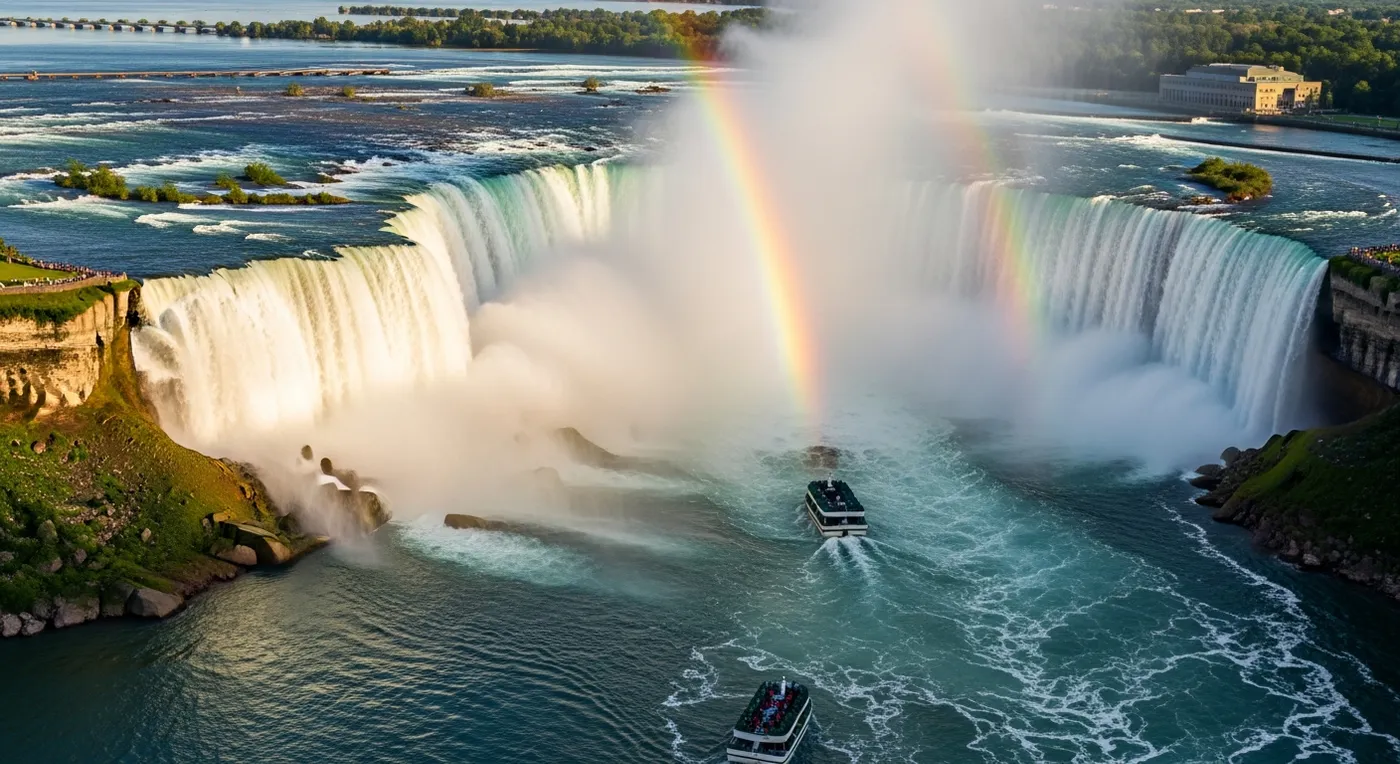
Horseshoe Falls — the moment everyone flies for
The Canadian Horseshoe Falls is the showpiece of the flight, and it earns it. Some 2,400 tonnes of water pour over its curved brink every second — around 90% of the Niagara River's entire flow. From the cabin you pass close to the rim, looking down into the emerald curve where the water goes glassy and smooth for an instant before it drops into the boiling white below.
On a sunny day the mist throws a full rainbow across the gorge, and you're often high enough to look right down through it. This is the single most photographed second of the whole tour, and it's the frame people set as their phone wallpaper for years afterward. If you take one deliberate breath and one steady photo on the entire flight, take it here.
One of the best birthday presents I've ever had. What a view of the city and falls from above.
— Jason, United Kingdom
Skylon Tower, the skyline and the clear-day bonus
After the falls, the helicopter banks and you get the wider picture: the Skylon Tower rising over the Canadian skyline, the hotel towers of Niagara Falls, Ontario, and Clifton Hill packed along the ridge. It's a quick shift in scale — from raw nature to the compact little city that grew up to watch it.
On a clear day, the horizon delivers a bonus. Look north and the Toronto skyline appears as a faint cluster of towers across Lake Ontario, roughly 50 kilometres away, with the CN Tower just visible as a needle. Turn the other way and Lake Erie stretches south. Not every flight gets the visibility for it, but when the air is clean, those distant horizons make the falls feel like the centre of a much bigger landscape. The return leg then carries you back over the lower Niagara River to the heliport.
For a full landmark-by-landmark breakdown of the route with a map of the flight path, see our complete guide to what you'll see on the flight.
Which seat is best on a Niagara helicopter tour?
Here's the honest answer: there is no bad seat. Every passenger gets a unbeatable views, and the Airbus H130's floor-to-ceiling windows mean the view wraps around the whole cabin. Because the route loops the falls, the aircraft banks in both directions, so the "good side" keeps changing anyway.
That said, a few small things help:
- Front seats beside the pilot give you the big forward windshield and an unobstructed downward view — lovely, and often assigned by weight-and-balance rather than request.
- The falls-side window on the approach is a treat, but the pilot deliberately banks so both sides get the showpiece. You won't miss it wherever you sit.
- Kids do well tucked between adults where they can lean toward the glass. All ages are welcome, and children under 2 fly free on a lap.
If you want the whole cabin to yourselves — for a proposal, a birthday or just an unobstructed run at every window — a private charter is the way to guarantee it. You can read how the tour and seating work before you book.
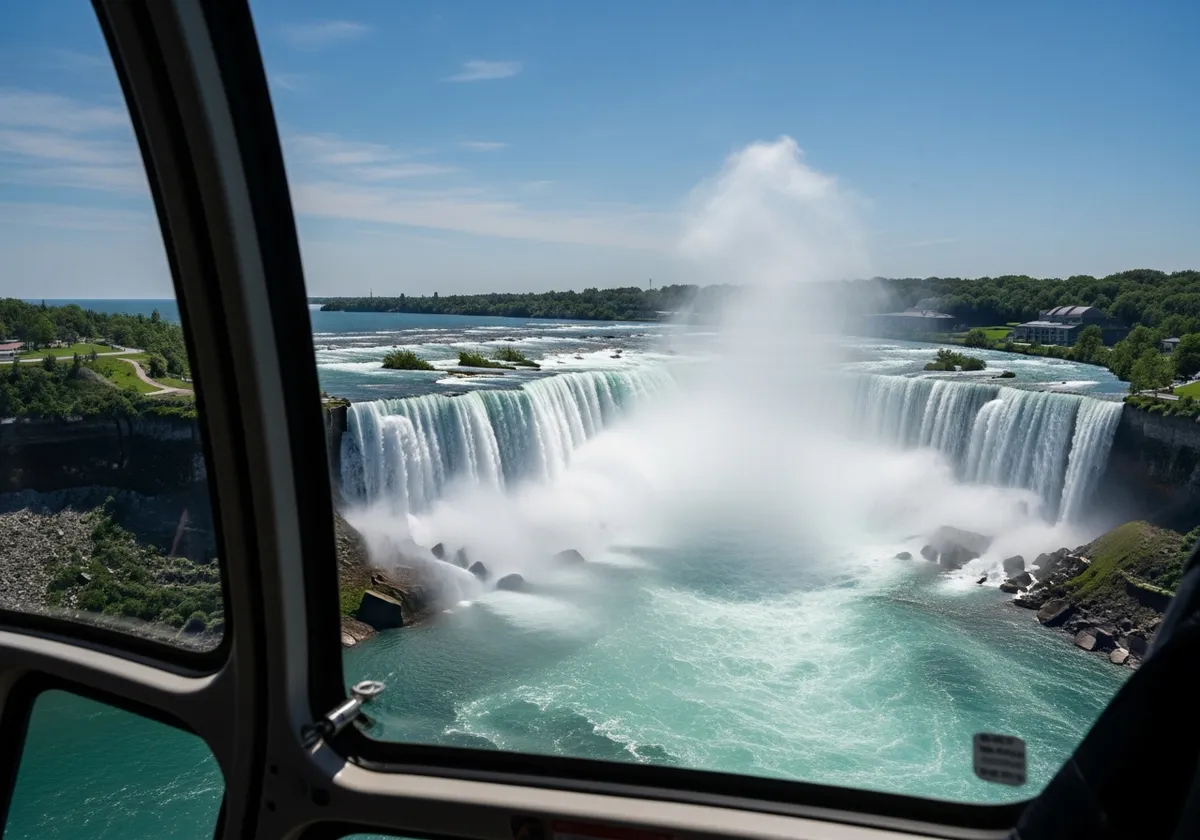
How do you photograph a Niagara Falls helicopter tour?
The flight is short and the light bounces around, so a little preparation goes a long way. These are the tips that make the biggest difference:
- Press your lens right up to the glass. This is the single most important trick. It kills reflections and cuts the glare from the window, so your shots look like open air instead of a photo taken through plexiglass.
- Wear dark clothing. A black or navy top reflects far less onto the inside of the window than a white or bright shirt. Fewer reflections, cleaner frames.
- Shoot in burst mode. The helicopter is moving and so is the water. Firing a quick burst gives you several near-identical frames to choose the sharpest from — far better than hunting for one perfect shutter press.
- Set your focus to the distance and leave it. Let the camera or phone lock onto the landscape rather than refocusing on the glass or the mist every time.
- Put the strap around your neck or wrist. Windows may be open on some seats, and you don't want a phone going overboard.
- Then put the camera down for the finale. Photograph the Whirlpool and the approach, but watch Horseshoe Falls go by with your own eyes at least once. No photo does it justice, and the memory is the thing you actually keep.
A phone in a steady hand pressed to the glass will out-shoot a fancy camera fumbled at the wrong moment. Keep it simple.
What you won't see (and why the timing matters)
The tour flies the Canadian side, so you won't get the head-on, ground-level wall of water that the boat tours deliver from the base of the falls. That's a different experience — closer, wetter, and worth pairing with the flight rather than choosing between. The helicopter trades proximity for perspective: it's the only way to see the entire river system, both countries and all three falls in one continuous view.
Timing changes the picture, too. Winter frames the falls in ice and snow; autumn lights the gorge with colour; summer brings the fullest flow and the best odds of a clear-day Toronto view. If you're deciding when to go, our guide to the best time to take a Niagara Falls helicopter tour breaks it down season by season, and if you're weighing this against a river cruise, see our helicopter vs boat tour comparison.
Quick answers before you fly
Do you really see all three falls?
Yes. The route passes American Falls, Bridal Veil Falls and Horseshoe Falls in sequence, with a close pass by the Canadian Horseshoe at the end. It's the only single experience that shows you all three from above.
How long are you actually looking at the falls?
The flight runs about 12 minutes end to end. The falls themselves fill the back half of it, with the Horseshoe approach as the climax. It's short, but it's dense — there's no dead time.
Is it worth it if the weather looks uncertain?
Flights run year-round, weather permitting, and if yours is grounded by weather you get a free reschedule or a full refund. So there's no risk in booking ahead even if the forecast is unsettled. For more of these, browse our frequently asked questions or get in touch and we'll answer directly.
Ready to fly?
Now you know exactly what rolls past the window — the river, the Whirlpool, the gorge, the bridges, the parks and all three falls, finishing on the brink of Horseshoe. The only thing left is to see it for yourself. Reserve your seats today, with free cancellation up to 96 hours before you fly.